Overview
Roon's Import Settings provide control over how Roon handles your music files.
When you modify import settings, Roon re-evaluates each file in your library taking the new settings into account. This approach allows for the settings to be both very powerful and totally non-destructive. That means that it's completely safe to change your library settings, you can always put them back the way they were later if you change your mind, and the result will be the same as if you never touched them in the first place.
Changing Library Settings Takes Time
This process can take a few minutes to complete, depending on the size of your library and the performance of your server. You can continue to use Roon during this time, but performance may be impacted, so it might not be the best idea to experiment with these settings during a party or a critical listening session.
Import Settings
Genre Settings
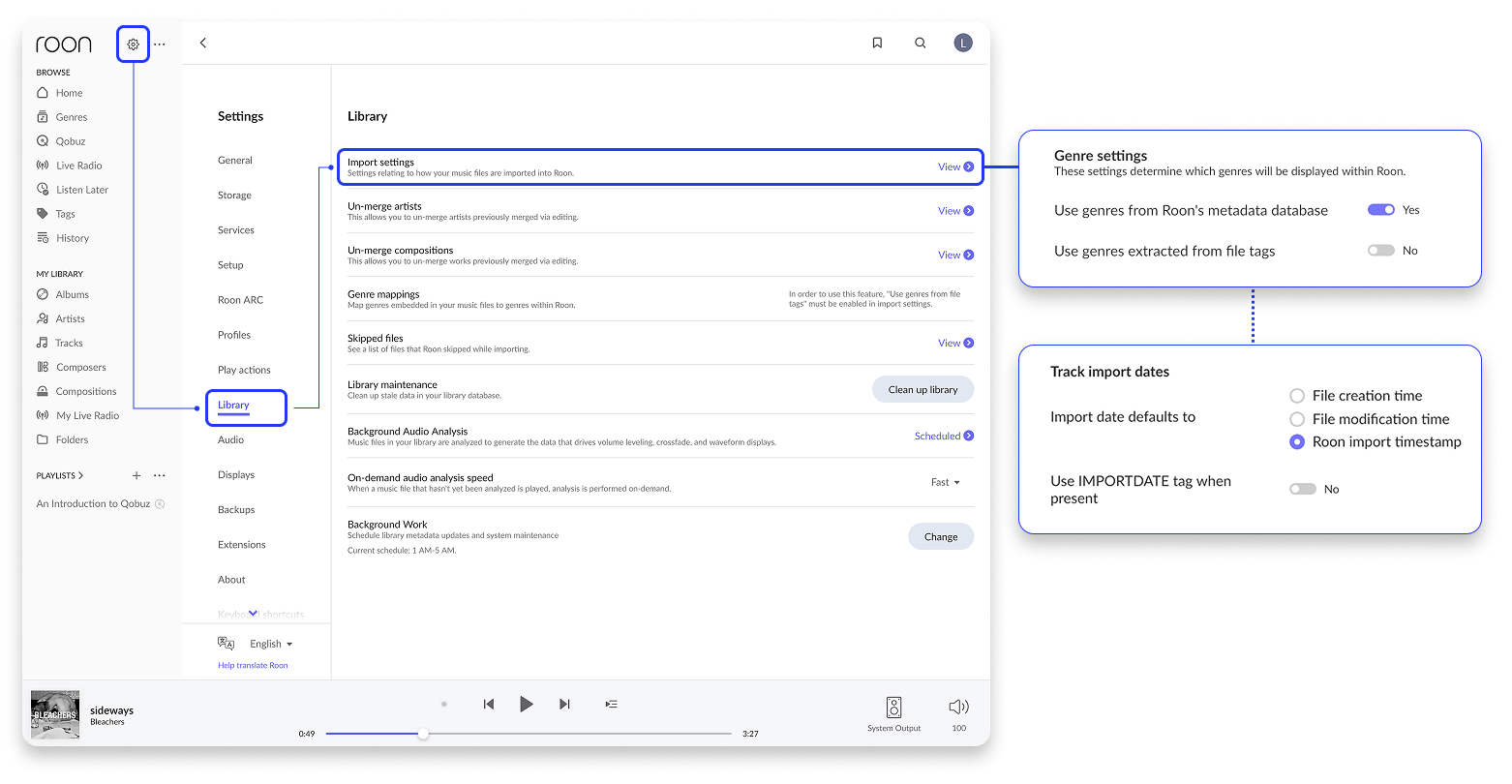
You can launch the import setting screen from Settings -> Library. By default, Roon assigns genres to albums and artists automatically and ignores genre information found in file tags. This produces a clean and consistent experience for the majority who do not have clean genre information in their files. If you want to exert more control over how genres are displayed in Roon, you might choose to enable both options, or to totally opt out of Roon's genre assignments and do it yourself.
For more in-depth information on managing genres in Roon, see
here.
Import Dates
Roon assigns a Date Added value to each track. By default, this date is based on the time the track was first imported into your Roon library (Roon import timestamp). If you'd prefer Roon to use a different date source, you can configure the Track import dates settings in Settings → Library → Import Settings.
Available date sources:
- File Creation Time. When selected, Roon uses the file system's creation timestamp as the track's import date. This can be useful if the file creation date closely matches when you originally acquired the music. However, results may vary depending on your operating system and how the files were copied or restored.
Note: On Linux-based systems, file creation times are not consistently supported and may not behave as expected. For extremely nerdy technical details of the effort to resolve this,
see here.
- File Modification Time. When selected, Roon uses the file's last modification timestamp as the import date. We generally do not recommend this option unless you understand how file modification dates are managed on your system. Many file operations can unintentionally update the modification timestamp, causing import dates to change unexpectedly.
- Roon Import Timestamp (default). Roon records the date and time when a track is first imported into your library and uses that value as its Date Added date. This option is the most predictable if you want Roon to manage import dates automatically.
- IMPORTDATE tag (recommended) is the most reliable method, and is a good solution for people who would rather manage this explicitly using external tools or scripts.
By default, Roon displays metadata from our metadata service instead of metadata found in your file tags when both are present.
Starting in Roon 1.1, we introduced "Prefer File" options in our Editing features, which enabled people to choose whether data from file tags or data from Roon's metadata database would be displayed on an album by album, track by track, field by field basis. This system was very flexible, and allowed for fine-grained tuning, but we received one piece of feedback over and over from our users: that there should be a way to express these preferences globally. So, in Roon 1.3, we introduced global versions of these settings.
You can find these settings under the Metadata preferences for Albums and Metadata preferences for Tracks sections in Import Settings. Note that Prefer File does not mean "File Tags Only". Roon considers track credits on a category-by-category basis and, for each category (Composer, Conductor, Ensemble, Main Performer, Performer, and Production), if no credits exist for the preferred metadata source (Roon or File), then Roon will look for them in the other source (File or Roon).
Composer credits have an additional level of complexity in that there is a distinction between _composition_ composer credits and _track_ composer credits. If we have Roon composition composer credits, but no track composer credits, we will go to your file tags and merge in anything that Roon doesn't already have; one reason for this is to cater for track-specific Arranger (Composer) credits.
This is, incidentally, why, if you've put something like "Beethoven, Ludwig van (1770-1827)" in your "COMPOSER" tags, it will appear alongside Roon's "Ludwig van Beethoven" in the composer credits. This behavior is deliberate. The reason that Roon applies as much credit metadata as it can is to provide rich and, in many many cases, unknown links between the different albums in your library. E.g. Drummer "Joe Shmoe" played on 7 albums in your library. This is fundamental to the Roon experience today and we're likely to leverage this even more in the future.
Album Version settings
Roon supports the idea of an album "version", which is usually a short piece of text that helps to provide identifying information about the album. Roon automatically populates the "Version" field from several locations based on a wide range of patterns we've observed in files "in the wild". If your library is more deliberately tagged, you may want to alter these settings to match your tagging practices.
File Tag Delimiters
When processing file tags, Roon splits fields based on certain delimiters. If you prefer, you can customize these. For example, if your track has a tag like this: ARTIST: Leonard Bernstein; New York Philharmonic Roon can recognize the `;` as a delimiter and split that tag into two separate artists, like this.
Roon's defaults are based on an analysis of millions of "real-world" files, and are generally considered to be safe, but if your library follows different conventions, you may need to change them. Note that Roon always treats a `NUL` character as a delimiter.
Finally, note that it is nearly always better to simply put separate values in separate tags. A file with two `ARTIST` tags instead of `Artist1; Artist2` will be more easily and unambiguously understood by virtually all software.
Delimiter Settings
When specifying multiple delimiters, please separate them with a space character.
Multi-character delimiters are supported.
The most common things people add are `'/'`, `'\'`, or `'|'`. These are relatively safe and do not generally cause problems.
This setting impacts Roon's parsing of the following tags:
COMPOSER, TCOM, ARTIST, PERFORMER, TPE1, TPE2, TPE3, ALBUM ARTIST, ALBUMARTIST, ALBUM_PERFORMER, SOLOIST, SOLOISTS, LYRICIST, VOCALS, VOCALIST, REMIXED BY, REMIXER, MIXARTIST, DJMIXER, MIXER, ARRANGER, ENSEMBLE, ENGINEER, AUTHOR, IWRI, WRITER, CONDUCTOR, ALBUM_ARTIST, PRODUCER, IPRO, FEATURING, TPUB, ORGANIZATION, LABEL
We caution strongly against adding a `','` as a delimiter for Artist/Composer/Label tags. Many real-life artist names contain commas, and this will make a mess out of your experience in Roon.
This setting impacts Roon's parsing of the following tags:
GENRE STYLE GENRES STYLES
Roon performs volume leveling using a target loudness of -14 LUFS, following the EBU R128 loudness standard. EBU R128 is an industry-standard method for measuring and normalizing perceived loudness, helping ensure that tracks and albums play at consistent volume levels without requiring manual volume adjustments.
When importing ReplayGain values, Roon adjusts the stored gain values to align with its EBU R128 target. If the file contains a REPLAYGAIN_REFERENCE_LOUDNESS tag, Roon uses that value as the source reference level. If no reference loudness is present, Roon assumes a reference loudness of -18 LUFS, which is the most common ReplayGain reference level.
When enabled, Roon imports ReplayGain metadata stored in your audio files and uses those values for volume leveling calculations. This can be useful if your library has already been analyzed by another application and contains ReplayGain information. If ReplayGain tags are not present, Roon will continue to use its own audio analysis to calculate loudness.
When enabled, ReplayGain values embedded in your files take precedence over Roon's own loudness analysis results. This option is intended for users who prefer to manage loudness normalization outside of Roon and want Roon to rely exclusively on the ReplayGain information stored in their files.
Troubleshooting Issues
Some tagging software displays one delimiter in its user interface, and then writes the delimiter out to your files differently. Very often, the thing displayed in the user interface is a semicolon, even though the underlying file ends up using something else.
These situations can be tricky to debug. Since your editor is showing you something different than what Roon is seeing. You can see information about how Roon is reading your tags using
View File Info. This can be very helpful when trying to figure out what's going on.


 Metadata Preferences
